Search

16 December 2025

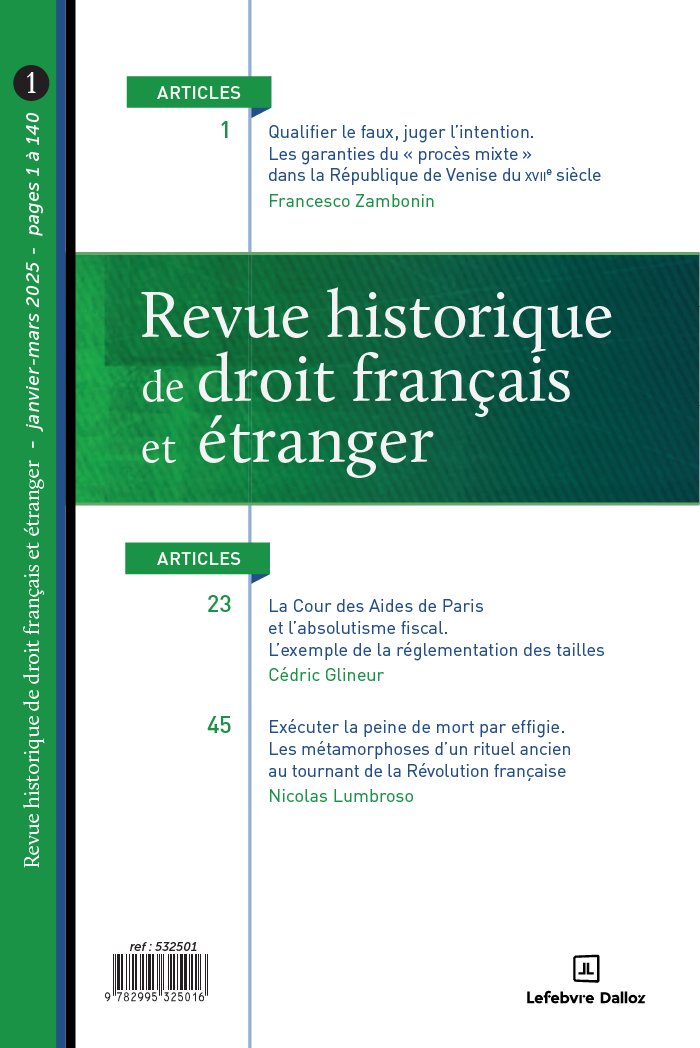
JOURNAL: The Journal of Legal History XLV (2024), No. 1


The Prosecution of Heresy in the Henrician Reformation (Paul Cavill) (OPEN ACCESS)

DOI 10.1080/01440365.2024.2320968
Abstract:

At the beginning of Henry VIII’s reign, the prosecution of heresy was based on three statutes of the late fourteenth and early fifteenth centuries. Under this system, the Church tried the crime with the assistance of secular authority. Juries presented suspects, whose cases were then transferred to the church courts for determination. In 1532, the Supplication against the Ordinaries challenged the conduct of heresy trials. It invoked common-law principles about due process and standards of proof. Two years later, a new statute modified the system, although less drastically than had been proposed. The royal supremacy and new religious policies changed the context in which heresy was prosecuted. Up until 1539, however, the church courts still determined accusations. Thereafter, in the case of specified heresies, the Act of Six Articles made lay juries responsible for determining guilt or innocence. Commissions under this act combined elements of canon law and common law. These reforms were, however, not seen to have improved the conduct of heresy trials. It proved easier to criticize the traditional method of prosecution than to devise a better one.

More Than a Species of Larceny: Fraud Laws and Their Uses in the Eighteenth Century (Cerian Griffiths) (OPEN ACCESS)

DOI 10.1080/01440365.2024.2320967
Abstract:

This article explores the under-researched area of fraud in the eighteenth and early nineteenth centuries. Fraud offences rarely feature in criminal law historiography, and where they do, they are positioned as an afterthought to theft and forgery. This article redresses this oversight and presents an in-depth analysis of eighteenth-century jurisprudence around frauds, providing a long-overdue mapping of the most common offences within this diffuse area of law. This article reveals the ways in which fraud offences were situated in the wider criminal law, and how frauds interacted with other property offences. This article maps the contours of the emerging modern offence of fraud, and in doing so makes the case for a rethinking of the significance of the criminal law of fraud and its place in the development of the modern criminal law. Finally, by assessing the ways in which fraud straddled the line between felony and misdemeanour, this article provides a lens through which to better understand eighteenth and early nineteenth century criminal procedure.


Subversion Down-Under: Innovation, Ambition and the Introduction of Survival of Causes of Action Legislation in South Australia and Victoria (Mark Lunney) (OPEN ACCESS)
DOI 10.1080/01440365.2024.2320964
Abstract:

For much of the twentieth century, the standard characterization of the relationship between the English common law metropole and the Dominion periphery has been one of the subservience and deference of the latter to the former. While the relationship was hierarchical, such characterizations undersell the innovation and ambition that the periphery, working within imperial legal constraints, could bring to the shared common law of the empire. This article considers the introduction of survival of actions legislation in two Australian jurisdictions, South Australia and Victoria, in the early 1940s. While based on the antecedent English legislation, both jurisdictions toyed with – and in South Australia’s case delivered – a much wider reform than took place in England. Rather than being mechanical recipients of law crafted in the metropole, Australian jurisdictions were well able to decide whether the English model was the best reform for their common law.

Scottish Legal History Group Report 2023 

Migrations of Manuscripts 2023 (John Baker)

Book reviews:

  • Common Law, Civil Law, and Colonial Law: Essays in Comparative Legal History from the Twelfth to the Twentieth Centuries edited by William Eves, John Hudson, Ingrid Ivarsen and Sarah B. White, Cambridge, Cambridge University Press, 2021, x + 338pp, £85.00 (hardback, also available as Open Access on Cambridge Core and in paperback), ISBN: 978-1-108-92512-9 (Joyman Lee)
  • Going the Distance: Eurasian Trade and the Rise of the Business Corporation, 1400–1700 by Ron Harris, Princeton, Princeton University Press, 2020, xi + 465 pp. (including index), £40 (hardback), ISBN 9780691150772 (Jonathan Hardman)
  • Lawyers at Play: Literature, Law, and Politics at the Early Modern Inns of Court, 1558–1581, by Jessica Winston; Law as Performance: Theatricality, Spectatorship, and the Making of Law in Ancient, Medieval, and Early Modern Europe, by Julie Stone Peters; Libel and Lampoon: Satire in the Courts. 1670–1792, by Andrew Benjamin Bricker, Oxford, Oxford University Press, 2022, vii & 270 pp., £20 (paperback), ISBN 9780192872326; Oxford, Oxford University Press, 2022, xiv & 350 pp., £70 (hardback), ISBN 9780192898494; Oxford, Oxford University Press, 2022, xii & 326 pp., £70 (hardback), ISBN 9780192846150 (Ian Ward)
  • Palles: The Legal Legacy of the Last Lord Chief Baron, edited by Oonagh B. Breen and Noel McGrath, Dublin, Four Courts Press, 2022, 256 pp (including index), €55.00/£50.00 (hardback), ISBN 9781801510356 (Richard McBride)
Read all articles here

BOOK: Cátia P. ANTUNES, Alejandro GARCíA-MONTON, Elisabeth HEIJMANS et al., A Hydra of Business and Men: The Habsburg Asiento de Negros in Structuring the European Transatlantic Slave Trade [Library of Economic History, eds. Jeremy LAND, Tomoko SHIROYAMA & Jeroen TOUWEN; 21] (Leiden/Boston: Brill, 2025), ISBN 978-90-04-74509-4 [OPEN ACCESS]


(image source: Brill)

Abstract:

This book offers a historical and historiographical analysis of the Spanish asiento de negros, a contract between the Spanish Monarchy and private parties to introduce specific number of enslaved Africans to Spanish America. As the Spanish American market was the largest single market for enslaved people prior to 1720, studying this colonial contract is essential for understanding the development of the most significant colonial contract of the long 17th century. The asiento framed the European transatlantic slave trade for nearly two centuries and shaped much of the political economy of the Spanish Atlantic empire. This book is unique in providing the first comprehensive study of the asiento since George Scelle’s 1906 work (La traite négrière aux Indes de Castille. Contracts et traités d’assiento, 2 vols.). Unlike Scelle, who focused on legal frameworks and presented the monarchy’s perspective, this book examines the asientistas themselves, offering insights into their business decisions and organizations. It concentrates on the period that gave rise to the idea of an asiento and the Habsburg-era asientos (1595–1713), preceding the so-called Bourbon reforms.

Discover the full book for free here: DOI 10.1163/9789004745094.

15 December 2025

BLOG SYMPOSIUM: Imperialism, Sovereignty and the Making of International Law at 20 (National University of Singapore)


(image source: NUS)

The Centre for International Law Dialogues of the National University of Singapore hosts a blog series on Anthony Anghie's seminal monograph Imperialism, Sovereignty and the Making of International Law (CUP, series Cambridge Studies in International and Comaprative Law, eds. James Crawford and John Bell).

Read more here.

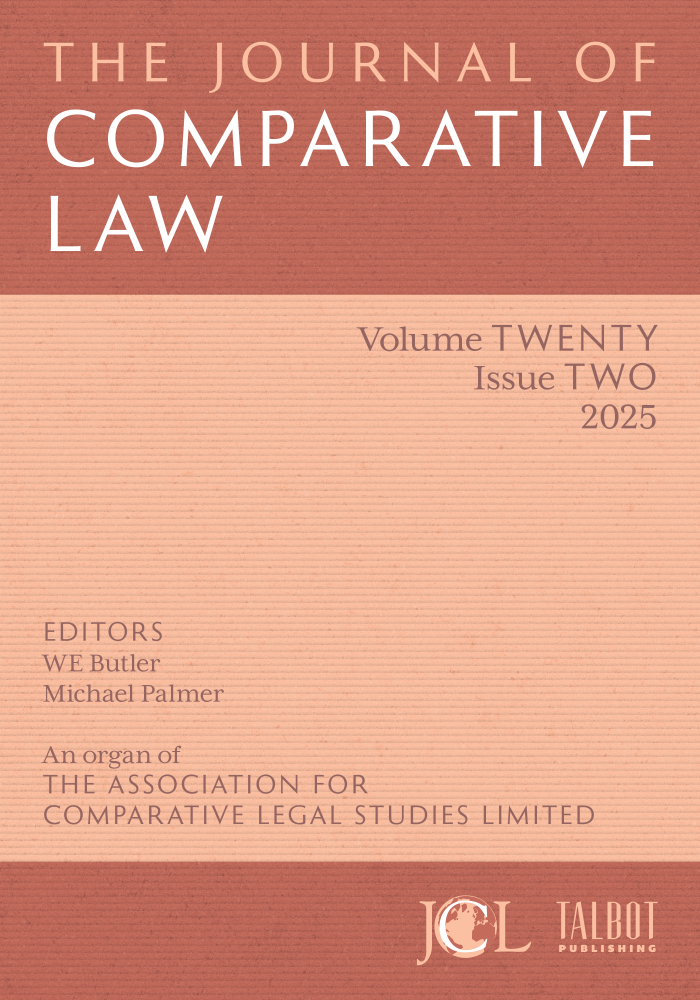
CALL FOR PAPERS: Global Law and Particular Legalities: Essays in Honour of William Twining (special issue in "The Journal of Comparative Law"; DEADLINE 9 JAN 2026)


(Image source: Lawbook Exchange)

When William Twining passed away on 9 October 2025, the global legal academy lost one of its most original and eclectic thinkers. Twining was a scholar of extraordinary range, leading debates not only within comparative law and comparative legal studies, but also within general jurisprudence, legal history, socio-legal studies, and the law of evidence. He argued passionately for legal scholarship as an open and inclusive enterprise, frequently magnifying voices from the Global South and fiercely critiquing what he saw as an over-reliance upon Anglo-American assumptions and perspectives within the academic writing of his peers. Twining can be credited not only with the meteoric rise of the ‘Law in context’ movement, but also with the expansion of general jurisprudence and the philosophy of law into fields such as legal pluralism and law and globalisation. For Twining, law was both everywhere and always from somewhere in particular. 

This special issue is dedicated to these, and other aspects, of Twining’s towering legacy. The guest editors invite the submission of abstracts of no more than 250 words by 9 January 2026, with an expectation that, if initially accepted, complete papers will be delivered no later than 30 June 2026, for final review and publication within the Journal of Comparative Law. Completed papers should be no more than 10,000 words, including footnotes. Submissions may concern any aspect of Twining’s intellectual or pedagogical legacy, however, the guest editors would particularly welcome abstracts and papers engaging with the following, either alone or in combination:

  • Comparative law and comparative legal studies as intellectual disciplines.
  • General jurisprudence, understood as both a descriptive and an inclusive enterprise.
  • Law both about, and within, the Global South.
  • Law, empire, and imperialism.
  • Law as a global and transnational phenomenon.
  • ‘Law in context’ as method and methodology.
  • Legal and normative pluralism.
  • Legal pedagogy and law teaching from a comparative perspective.
  • Legal realism in historical and comparative perspective(s).
  • Socio-legal studies and its connection(s) to comparative law.
  • The law of evidence in comparative perspective(s).

Abstracts are particularly welcome from scholars from the Global South, as well as from early career academics and colleagues with backgrounds otherwise under-represented within the academy. Initial submissions should be sent, together with a short biography of no more than 150 words, to Prof. Alex Green at aggreen@cuhk.edu.hk.


Guest Editors:

  • Prof. Alex Green (文浩航), Associate Professor, Chinese University of Hong Kong; Academic Associate, 23ES Chambers (London and Manchester)
  • Prof. Jennifer Hendry (文林言), Professor, Chinese University of Hong Kong; Academic Associate, 23ES Chambers (London and Manchester)

BOOK: Brecht DESEURE (ed.), Constitution de la Belgique. Projets et propositions pour la constitution belge de 1831 : édition critique (Brussels: Commission royale pour la publication des anciennes lois et ordonnances de Belgique/SPF Justice, 2020), 469 p. ISBN 9782960272406 [OPEN ACCESS]


Dr Brecht Deseure (ULB/KBR, FedTWin) has brought together 282 pages of drafts of the Belgian Constitution, debated and adopted in record time by the National Congress between November 1830 and February 1831.

This volume collects texts by Simon Merlin, Antoine Becart, Ferdinand Paridaens, Charles-Hyppolyte Vilain XIIII, Charles Moulan, Adolphe Bayet, Louis Glorieux, Joseph Mouremans, Joseph-Ferdinand Toussaint, François Grenier, Joseph Forgeur, Jean-Pierre Barbanson, Joseph-Stanislas Fleussu, Charles Liedts, Victor Delecourt, Charles Moulan, as well as several anonymous texts.

The editor has also prepared bio-bibliographical notes in Dutch, French, and English.

In the appendices, readers will find the draft Belgian Constitution of the Provisional Government, the text of the Constitution of February 1831, together with a chronology, a bibliography, and an index of names and subjects.

The Royal Commission for the Publication of the Ancient Laws and Ordinances of Belgium welcomes the availability of this work of primary importance for a broad audience through the website rechtsreeks.be (an initiative of the Library of the Faculty of Law and Criminology at KU Leuven).

The international significance of this publication is reflected in its association with the ERC Advanced Grant project ReConFort (University of Passau), within whose framework the volume has been published.

The book includes a foreword by the then Minister of Justice and Deputy Prime Minister, Mr Vincent Van Quickenborne (pp. 5–7).


The text can be accessed at this link.


12 December 2025

CONFERENCE: Protestantisme et pensée juridique (Malakoff: Université Paris Cité, 15-16 DEC 2025)

(image source: Wikimedia Commons)

Lundi 15 décembre, 14 h 00, sous la présidence de Pierre-Yves Quiviger, directeur de l’UFR de philosophie, Université Paris 1 Panthéon-Sorbonne


Guerric Meylan, maître de conférences en histoire du droit, université Paris-Saclay, Les Termes de l’Alliance selon Jean Calvin : proposition de lecture institutionnelle du Décalogue (Ex., 20)
Attila Pokecz Kovacs, professeur d’histoire du droit, université nationale du service public et université réformée Károli Gáspár de Budapest, L'influence du calvinisme sur la pensée juridique européenne et la jurisprudence : le cas de la Hongrie
Fabrice Bin, professeur de droit public, Science po Toulouse, Le devoir du contribuable et la légitimité de la loi fiscale à partir de Luther et Calvin
Paolo Astorri, professeur associé d’histoire du droit, université de Copenhague, Reforming Marriage, Reforming Law: Parental Consent and the Juridical Culture of Lutheranism 

Sous la présidence de Marianne Carbonnier-Burkard, maître de conférences honoraire à l’Institut protestant de théologie
Arnaud Le Gonidec, docteur en histoire du droit, université Toulouse Capitole, La condamnation de l'Eucharistie par les juristes protestants français de la seconde moitié du XVIe siècle: arguments juridiques
David El Kenz, maître de conférences en histoire moderne, université Bourgogne Europe, Les « héros de la foi » au XVIe siècle : le droit, à l’origine de la martyrologie protestante
Romain Dubos, docteur en histoire du droit, université Paris 1 Panthéon-Sorbonne, Un combat humaniste contre l'absolutisme : la Prinicipum monitrix musa d'Henri Estienne (1590)
Adrien Boniteau, docteur en théologie protestante, université de Strasbourg, Protestantisme et contractualisme : de l'alliance théologico-juridique des monarchomaques au contrat social de Thomas Hobbes 


Mardi 16 décembre, 09 h 30, sous la présidence d’Anne Rousselet-Pimont, codirectrice de l’École de droit de la Sorbonne, université Paris 1 Panthéon-Sorbonne


Clara Cwikowski, enseignante contractuelle en histoire du droit, université de Toulon, La conception de la loi et du contrat dans la littérature protestante sur la tolérance civile en France au XVIIIe siècle
Alexis Verhassel, doctorant en histoire du droit, université de Montpellier, Kant et le renversement des catégories du droit romain
Florian Reverchon, professeur d’histoire du droit, université de Toulouse, Enseigner le droit canonique en terre protestante : le Kirchenrecht dans les facultés de droit allemandes (XVIIe-XXe siècle)
Julien Broch, maître de conférences en histoire du droit, Aix-Marseille université, La part protestante de l’esprit du droit républicain : Jules Simon et la doctrine de la liberté dans l’ordre
Franck Zarlenga, docteur en histoire du droit et chercheur associé à Institut d’histoire du droit, Université Paris Cité, L’influence du droit protestant sur la nature juridique de l’Église dans le processus de séparation des Églises et de l’État
Jean-Pierre Jézéquel, directeur de recherche émérite, Institut national de l’audiovisuel, Ellul protestant et juriste

14 h 30, sous la présidence de Bruno Daugeron, directeur de Centre Maurice Hauriou, université Paris Cité
Isabelle Kalinowski, directrice de recherche, UMR Pays Germaniques (UMR 8547, CNRS/ENS), Les références au droit dans L'Éthique protestante et l'esprit du capitalisme de Max Weber
Quentin Roueche, doctorant en philosophie, université Paris 1 Panthéon-Sorbonne, Le paradoxe de l'individualisme politique protestant selon le juge Jerome Frank : éléments pour une théologie réformiste et réaliste
Adrien Aracil, docteur en histoire moderne, Sorbonne université, Le régime de l’édit de Nantes peut-il être un régime juridique ? Institutions réformées et pensée juridique dans la France du premier XVIIe siècle
Cyril Selzner, maître de conférences en langue et littératures anglaises et anglosaxonnes, université Paris 1 Panthéon-Sorbonne, Droit et radicalité de la conscience : les quakers et le serment au XVIIe siècle
Gilles Dumont, professeur de droit public, université Paris Cité, Existe-t-il une science administrative protestante ?
Sylvain Bloquet, maître de conférences en histoire du droit, université Paris Cité, Protestantisme et doctrine civiliste du XIXe siècle à Jean Carbonnier
Céline Borello, professeur d’histoire moderne, université du Mans, Conclusion


Practicalities:

Salle Jean-Pierre Machelon, Faculté de Droit, d’Économie et de Gestion, Université Paris Cité (10 avenue Pierre Larousse, 92240 Malakoff)

ARTICLE: Laurine MANAC'H, "Historiciser et politiser le pouvoir administratif", Rives Méditerranéennes 67 (2025), 169-185 [OPEN ACCESS]


(image source: openedition)

First paragraph:

Peut-on et comment faire l’histoire du « pouvoir administratif » dans des sociétés d’Ancien Régime qui ne connaissent pas de séparation des pouvoirs ? À condition de se défaire de l’idée téléologique d’une fonction et d’une organisation autonomes au sein du système de pouvoirs, dont la réalité ne remonte qu’au xixe siècle en Occident, et d’envisager avant tout le pouvoir « d’administrer », c’est-à-dire la capacité et la pratique de gouverner les hommes et les choses, il est possible d’analyser les manifestations historiques du pouvoir administratif. De l’ouvrage collectif coordonné par François Godicheau et Mathieu Grenet, il ressort plus encore que cette analyse, conduite dans une perspective transdisciplinaire au croisement de l’histoire politique et de l’histoire du droit, contribue plus généralement à la compréhension des enjeux politiques et institutionnels de l’action publique.

Read more here: DOI 10.4000/153ku.

BOOK REVIEW: Sara L. KIMBLE on International law and women’s history: historical methods for egalitarian scholarship: A Review of Portraits of Women in International Law: New Names and Forgotten Faces?, edited by Immi Tallgren (Comparative Legal History, XIII (2025), nr. 2 (December), pp. 306-314)

(Image source: Taylor&Francis)


Nearly a century ago, Virginia Woolf asked ‘If Shakespeare Had a Sister’ in A Room of One’s Own Woolf imagined Shakespeare’s sister who was equally gifted, ‘as adventurous, as imaginative, as agog to see the world as he was’ but denied access to school, books, and the opportunities for intellectual work. Talent with no room to develop would spell only grief for Shakespeare’s hypothetical sister, Woolf concluded. The cause of ‘Judith Shakespeare’s’ tragedy, however, was not on her shoulders alone but rather on the patriarchal society that limited all women’s access to education, shackled them to unending domestic and reproductive duties, and prevented their civic, financial, and personal independence.
Historians and legal scholars are still writing about the ways in which women struggled against societal, legal, religious, scientific, and educational limits to seek lives of meaning and satisfaction according to their own potential. In Portraits of Women in International Law, edited by Immi Tallgren, we have legal history’s corollary: what of Hugo Grotius’s wife, Maria van Reigersberch? Her current place in history is that of a wife loyal in service to her husband. But in Tallgren’s volume we meet an intrepid, intelligent woman who was resourceful and knowledgeable about finances, spoke boldly to court officials, sought contracts with printers, and travelled independently. Readers are encouraged to ask: did Grotius’s wife also make contributions to legal thought beyond saving the life of her husband, the man whose writings laid the foundations for international law as recognised today?

To read the full review, please click here. Online access is free for members of the European Society for Comparative Legal History. For further information about the volume on our blog, please visit here.

DOI: 10.1080/2049677X.2025.2580105


10 December 2025

VACANCIES: 14 PHD Positions in Cultural Heritage - Cultural Heritage Outreach in RomAnce Languages (MSCA CoFund) (DEADLINE 17 JAN 2026)

(image source: wikimer)


Presentation

  • Selected candidates will be enrolled in PhD programmes under joint supervision, awarding a double degree and requiring international mobility.
  • High-Quality Training: Receive expert-led research training through the UNITA Alliance’s dedicated Cultural Heritage Hub, encompassing diverse fields within and beyond cultural heritage.
  • Comprehensive Support: Benefit from dedicated guidance from the initial stages of your PhD to professional integration.
  • Transformative Impact: Contribute to the socio-economic and cultural transformation of rural and cross-border mountain territories.
  • Financial Support: Includes travel, mobility, and research costs.
  • Double Degree: Graduate with a double degree from two European universities.
  • Funding: 3-year fully funded PhDs, starting autumn 2026
How to Apply
  • A CV (template provided) that includes all personal information, education background, research activities (if any) and information about two referees
  • Two Reference letters (in a single PDF file): each referee will submit a letter concerning the applicant’s previous research activities and the applicant's research capacity and working experience
  • A personal statement (template provided - maximum of 5 pages) that includes general motivation letter for participation in CHORAL and the research topic, qualifications and achievements, career development objectives, collaboration requested beyond higher education sector for short stays
  • An ethics and security issues self-assessment
  • A copy of the Master’s degree and academic transcripts translated into English; Candidates waiting for their diploma to be officially issued must submit their marks and rankings
  • Copies of certificates of English language proficiency (for non-English native speaking applicants): Cambridge First Certificate or equivalent, TOEIC, TOEFL, a certificate of your Master’s university attesting the English
  • Copies of a valid identity card (for EU citizens) or a valid passport (for visa application if selected)
  • A declaration on honour (template provided) about the conformity of the mobility information
Fellowship conditions
  • France: 2300€/month
  • Italy: 2270€/month
  • Spain: 2164€/month
  • Romania: 2740€/month
  • Mobility allowance up to 4500 € over the 3-year period to partially cover travels, accommodation, etc. linked to secondments for the project duration.
  • Conference allowance up to 3500 € over the 3-year period of the PhD, to cover expenses related to the travel for attendance or participation to conferences, workshops.
  • Research allowance of 5000€ over the 3 years to cover expenses related to the research;
Scientific coordination
  • Université de Pau et des Pays de l’Adour (UPPA - France)
  • Université Savoie Mont Blanc (USMB - France)
  • Università degli studi di Torino (UNITO - Italy)
  • Universidad de Zaragoza (UNIZAR - Spain)
  • Università degli Studi di Brescia (UNIBS - Italy)
  • Universitatea Transilvania din Brașov (UNITBV - Roumania)

As part of the UNITA Alliance, 14 excellent Doctoral Candidates (DCs) will enrol the CHORAL programme in Cultural Heritage.

UNITA is an alliance of twelve universities supported by the European Union. Launched in November 2020, the alliance is helping to build the European Higher Education area. The partner universities, all of which are in Romance-speaking countries, have in common that they are located in mountainous and border areas.

Coordinated by the Université de Pau et des Pays de l'Adour, CHORAL (Cultural Heritage Outreach in RomAnce Languages) is a Horizon Europe Marie Skłodowska-Curie programme co-funded by the European Union. This prestigious programme is linked to the Cultural Heritage Hub, an international research network within the Alliance, which structures its research ecosystem facing cultural related challenges.

CHORAL aims to train high-quality international researchers and to nurture the development of interdisciplinary, international and inter-sectoral research that addresses any aspect of Cultural Heritage. While rooted in cultural heritage, the programme spans a wide range of scientific domains, including architecture, anthropology, arts and culture, computer science, history, literature, linguistics, management, musicology and more.

Applications are open until January 17, 2026 for 14 grants on multiple PhD research topics in 6 Universities of the UNITA Alliance for fully funded 3-years PhDs, starting on autumn 2026 : https://aap.univ-pau.fr 

The application form should contain all the following mandatory documents:

Detailed information about the PhD Research Topics and the conditions to apply: https://www.research.univ-unita.eu/en/choral-project.html

CHORAL fellows will benefit from the following advantages:

The monthly gross salary will depend on the recruiting country. The following list presents an indicative gross salary after employers' taxation, provided as guidance. The salary gross amount may be subject to changes corresponding to taxes increases/decreases 

The net salary amount may be subject to changes and corresponding personal tax position.

20 PhD Research Topics for 14 positions in 6 universities within the UNITA Alliance.

Read more on calenda.

PRIZE: American Society for Legal History Article Prize to Grace MALLON (co-winner), "Negotiated Federalism: Intergovernmental Relations on the Maritime Frontier, 1789-1815"


(image source: Rothermere American Institute, Oxford)

On the article:

Grace Mallon’s “Negotiated Federalism” examines the federal government’s efforts to enforce its new authority after the Founding. Federal officials quickly realized that they required the participation and consent of state governments, as federal laws could not take effect without the legislation, investment, and manpower of state governments. The piece showcases how Atlantic port cities presented a crucial test case for negotiated federalism, where the federal government sought to exercise power in spaces where states had already entrenched their authority. As early federal officials set up customs and lighthouse services, rebuilt coastal fortifications, and enforced regulations, they had to negotiate with states to determine “which powers each level of government could exercise.” As a result, federal power depended on a state’s willingness to negotiate its authority. The crisply written article tackles big questions of federalism through granular details of practical problems and personality conflicts. Based in impressive primary source research in state and federal official records and correspondence, Mallon brings multiple areas of scholarship together to describe how power was worked out ‘in the course of ordinary government administration instead of in high theory. “Negotiated Federalism” takes something that we feel is well-understood (federalism at the founding) and through a creative path through the archive mines new and provocative ways of seeing the past that help us see the present more clearly.

Link to the article here: 10.1353/wmq.2024.a941486 

(source: RAI - Oxford University

PRIZE: d'Aguesseau Thesis Prize 2025 to Francesco Saverio TAVAGLIONE (ULiège), "Entre punition et réparation. Pour une histoire culturelle de la fonction de la responsabilité aquilienne"

(image source: daguesseau.fr)

Announcement:

Le jury du Prix d’Aguesseau s’est réuni le 1er décembre 2025. À l’unanimité des présents lors de la délibération, c’est la thèse de Monsieur Francesco Saverio Tavaglione, « Entre punition et réparation. Pour une histoire culturelle de la fonction de la responsabilité aquilienne« , soutenue à l’Université de Liège, thèse conduite sous la direction de Mme Patricia Giunti et M. Jean-François Gerkens, qui a été retenue comme lauréate.

Read more here


VACANCIES: Turku Institute for Advanced Studies opens up to 10 postdoctoral positions [Marie Skłodowska-Curie COFUND] (Turku: University of Turku, DEADLINE 6 JAN 2026)

(image: Autumn in Turku; Source: Wikimedia Commons)

Turku Institute for Advanced Studies (TIAS) has opened a call for up to ten research fellows to join its new Turku Intersectoral Excellence Scheme 2 (TIES2) programme. The programme offers excellent, internationally mobile researchers the opportunity to undertake a three-year research project of their own design.

TIES2 builds on the success of the original TIES, and it has a 2.7M € funding from the European Commission’s Marie Skłodowska-Curie (MSCA) COFUND programme.

A launch and information event for TIES2 will be held online on Tuesday 9 December 2026 between 14.00 and 16.00 (EET). TIAS Director Martin Cloonan will be joined by Professor of Practice Patrik Anckar and TIES Fellow Dr Ranjana Saha.

TIES2 requires its Fellows to undertake a secondment outside of higher education for period of between three and twelve months. TIAS has developed a range of new partnerships, including:

TIES2 will see up to ten Fellows join TIAS in September 2026. As the MSCA programme is designed to increase worker mobility, applicants must not have lived in the host country, Finland, for more than 12 months in the previous 36 at the time of call deadline 9 January 2026.

– I am delighted that the MSCA has seen the merits of the TIES programme and awarded us extra funding. We have very much enjoyed having the TIES Fellows with us and are looking forward to welcoming more in September next year, TIAS Director Professor Martin Cloonan said.

The TIES programme been specifically designed to meet a number of demands from a range of policy bodies, including The Finnish Ministry of Education and Culture’s National Roadmap for Research, Development and Innovation, as it promotes intersectoral working, aims to attract international talent and to help to solidify a fragmented research sector; and the EU’s Innovation Union flagship, which aims to increase competitiveness, provide jobs and stimulate growth.

More information here.

JOURNAL: Justices manifestes. Écrits, rituels et procédures judiciaires au Moyen Âge et à l'époque moderne, dir. Elisabeth SCHMIT & Aurélien PETER (Clio@Thémis 29 (2025) [OPEN ACCESS]

(image source: openedition)

Introduction (Élisabeth Schmit & Aurélien Peter)
DOI 10.4000/156ok
First paragraph:

Ce dossier se situe au croisement de deux manières d’aborder et d’écrire l’histoire de la justice1 : celle, d’une part, qui s’intéresse aux manifestations rituelles du processus judiciaire ; et celle, d’autre part, qui traite des enjeux et des pouvoirs de l’écrit dans l’action de la justice. En repartant de la métaphore théâtrale, c’est-à-dire en envisageant la scène judiciaire comme cadre spatio-temporel du déploiement du rituel, il s’agit d’en étudier précisément les modalités d’enregistrement, pour mieux comprendre comment l’écrit participe du caractère manifeste des justices médiévales et modernes – dans leur diversité. À l’intersection entre rituel et écrit judiciaires, il y a bien sûr la procédure, entendue à la fois comme la succession des étapes conduisant à l’exécution d’une décision de justice, et comme l’ensemble des règles qui encadrent chacune de ces étapes. Faire l’histoire des modalités d’enregistrement du rituel judiciaire implique dès lors d’expliciter à la fois les rapports entre rituel et procédure, et entre procédure et écrit. Les contributions qui suivent témoignent de l’intérêt, pour les historiennes et historiens de la justice, d’articuler ces deux approches, chacune ayant fait l’objet d’une historiographie féconde.

Ad arbitrium dicte nostre curie. Les équilibres de la jurisprudence du Parlement criminel au travers de l’enregistrement des peines infamantes (xive siècle) (Isabelle d'Artagnan) 
DOI 10.4000/156ol
Abstract:

This article analyzes recording strategies shaping parliamentary judicial precedents through seventy 14th century rulings involving the pillory or honorable amend. Clerks selected cases, merged uses of degrading punishments, and erased discrepancies to portray a moderately balanced justice. Three principles guided sentencing: the extent of the harm caused, the status of the parties involved, and the course of the judicial process. The criminal registers appear as a selective memory which guides the magistrates’ practice more than it records it.

 (D)écrire la procédure judiciaire criminelle à Dijon à la fin du Moyen Âge (Rudi Beaulant)
DOI 10.4000/156oo
Abstract:

The excellent preservation of sources relating to Dijon’s municipal justice system provides insight into the various stages of criminal proceedings in the late Middle Ages. Thanks to the diversity of the documents, it is possible to trace the rationalization of the content of the registers and notebooks from the second half of the 14th century to the beginning of the 16th century, which became ordinary judicial writings used in particular to facilitate the work of judges and prosecutors and, above all, to attest to the good judicial governance of the municipality, which also involved the political ritual of the inauguration of officers.

Pratiques de l’écrit et procédures de la justice ordinaire dans les villes allemandes à la fin du Moyen Âge (Dominique Adrian)
DOI 10.4000/156om
Abstract:

A trial before the council of Kempten (now in Bavaria) in 1486 offers a firsthand insight into the procedure followed in the urban courts of the late Middle Ages, for which the normative texts give only a limited account. The considerable weight of witness testimony and the complexity of the procedures used to gather it show the concern to establish an objective truth, without resorting to irrational evidence (purgatory oaths, etc.). By drafting this lengthy charter at the request of the litigants, the council aimed to guarantee the legal solidity of its decision, even in the face of the imperial courts then in full expansion.

Rendre des comptes au xvie siècle : les pratiques juridictionnelles de la Chambre des comptes de Paris dans les comptabilités urbaines de Touraine (Rémi Demoen)
DOI 10.4000/156on
Abstract:

During the Ancient Regime, the chambre des Comtes de Paris was a sovereign court whose task was to audit the accounts of all the agents who had to manage the king's funds. The ritualised practice of this exercise of control is based on a jurisdictional power that, while well researched for the late Middle Ages, remains dependent on documentary losses for the 16th century. Municipal accounts from this period offer a valuable alternative. Because they preserve traces of the judicial ritual in the Chamber as much as they are an integral part of it, these documents make it possible to propose a renewed study.

De petits bois de justice Les bandeaux gravés de Jean-Michel Papillon dans le rituel judiciaire à la fin de l’Ancien Régime (Mathias Boussemart)
DOI 10.4000/156op
Abstract:

Among the engravers producing illustrated headpieces at the end of the Ancien Régime, the renowned Jean-Michel Papillon (1698-1776) worked regularly for the judicial world, notably creating numerous headpieces related to parliamentary activity. The study of his Recueil des Papillons, held at the BNF, makes it possible to analyze in detail these seemingly innocuous images, which reveal the wide diffusion of an iconographic language shared by the judicial world of the Ancien Régime, through the miniature staging of its ritual.

Varia

De la difficulté de devenir fonctionnaire de l’État français dans un protectorat : l’exemple des contrôleurs civils au Maroc (Quentin Lohou)
DOI 10.4000/156oq
Abstract:

By establishing a “protector” state and a “protected” state, the French protectorate in Morocco recognizes the exercise of two sovereignties over the Cherifian Empire. This regime gave rise to some original legal situations, as illustrated by the hybrid status of civil controllers: these civil servants of French nationality embodied French sovereignty in Morocco, but were denied the status of civil servants of the French State until 1955. Gathered in an amicale, they strove to obtain this status until 1930.

Un fondement canonique du pouvoir constituant médiéval : « exercitus imperatorem faciat » (Decretum I, D. 93, c. 24 Legimus)
DOI 10.4000/156or
Abstract:

The Legimus canon (Decretum I, D. 93, c. 24), derived from a letter by Saint Jerome around the year 400, incidentally mentions : « exercitus imperatorem faciat ». However, the lex regia was already intended to provide, since the doctrine of Irnerius († 1130), the foundation of imperial power. Yet, by the late 12th century, the canonist Huguccio established the Legimus canon as a new foundation of imperial power within a dualist perspective. From then on, the doctrine appropriates this canonical foundation, leading to the conception of a constituent power now based on common law, or even the law of nations.

Point de vue

The many territories of Roman law (Dario Mantovani)
DOI 10.4000/156ot
Abstract:

From the 11th century onward, the study of ancient Roman law has been marked by contrasting impulses. One the one hand, Justinian’s Corpus Iuris Civilis was reinterpreted as a body of law detached from historical and geographical specificity, revitalized through academic teaching and functioning as positive law in numerous European contexts (and beyond) from the Middle Ages to the Modern era. On the other hand, when examined in its original context, it remains the law of a specific region – however vast the Roman Empire may have been. Although traditionally tied to the education of jurists in law schools, its study has also demanded a philological and historical approach to enable accurate reconstruction. Roman legal history thus stands as a telling example of the complex relationship between a geographically anchored perspective and a deterritorialized one, and between specialization and interdisciplinarity. Though often regarded as a traditional field, Roman legal history – by virtue of its layered and ambivalent legacy – has also, in key ways, prefigured contemporary methodological innovations in the social sciences and humanities.

 Read the full issue in open access here.


09 December 2025

VIDEO: Le juge d’instruction (19e-20e) (Les Lois de L'histoire, Université Sorbonne Paris Nord)


Presentation:
Vous connaissez sans doute le nom et le visage d’un juge d’instruction : les médias ont en effet mis en avant plusieurs figures de cette institution judiciaire qui s’occupe de nombreuses affaires sensibles. Mais vous ignorez peut-être son histoire multiséculaire en raison, paradoxalement, de la surmédiatisation de ce juge présenté, à tort, comme incontrôlable et omnipotent. La réalité est bien différente : si le juge d’instruction peut faire beaucoup de choses, il ne peut faire n’importe quoi et encore moins le faire seul. Ses pouvoirs sont encadrés par des devoirs et contre-pouvoirs importants depuis le début du 19e siècle. Quels furent ses devoirs ? Qui furent les autres acteurs du monde judiciaire avec lesquels le juge d’instruction travaillait ? Comment était-il nommé ? Était-il vraiment indépendant ? Pouvait-il emprisonner discrétionnairement les suspects ? Voilà quelques-unes des questions posées à l’historienne du droit Blandine CARON que j’ai eu le plaisir de recevoir le lundi 24 novembre 2025 dans les studios des Lois de l’Histoire.